

Astronomers search for light that holds answer to how earliest galaxies formed
Webb will be a powerful time machine with infrared vision that volition peer back over 13.5 billion years to run across the first stars and galaxies forming out of the darkness of the early on universe.

Early on Universe

Out of the Darkness
+
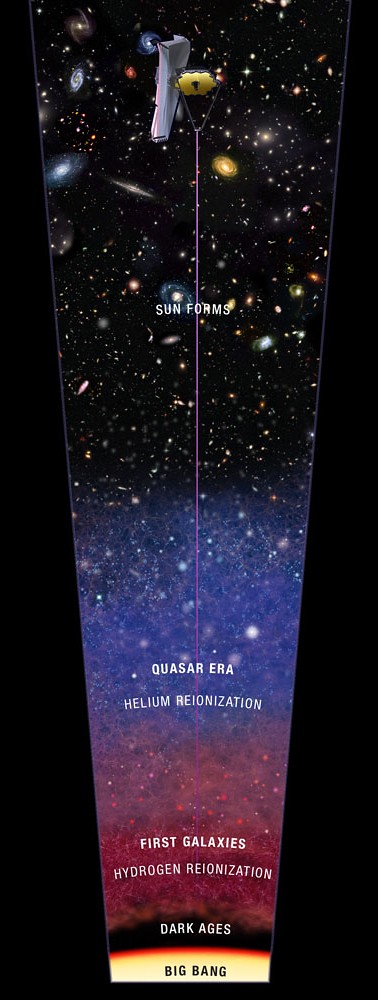
Webb will be able to see back to when the beginning bright objects (stars and galaxies) were forming in the early universe. Credit: STSci
- Cardinal Concepts
- In Depth
- Related Content
Why Infrared?
Why is a powerful infrared observatory key to seeing the first stars and galaxies that formed in the universe? Why do we even want to see the first stars and galaxies that formed? 1 reason is... we oasis't all the same! The microwave COBE and WMAP satellites saw the oestrus signature left by the Big Bang near 380,000 years afterwards it occurred. Simply at that point at that place were no stars and galaxies. In fact the universe was a pretty dark place.
The Early Universe
Later on the Big Bang, the universe was like a hot soup of particles (i.eastward. protons, neutrons, and electrons). When the universe started cooling, the protons and neutrons began combining into ionized atoms of hydrogen (and eventually some helium). These ionized atoms of hydrogen and helium attracted electrons, turning them into neutral atoms - which immune light to travel freely for the first fourth dimension, since this light was no longer handful off free electrons. The universe was no longer opaque! However, information technology would still exist some time (perhaps up to a few hundred million years mail service-Large Blindside!) before the offset sources of lite would start to form, ending the cosmic dark ages. Exactly what the universe'south kickoff low-cal (ie. stars that fused the existing hydrogen atoms into more helium) looked like, and exactly when these first stars formed is not known. These are some of the questions Webb was designed to assistance usa to answer. Come across also our Q&A with John Mather well-nigh the Big Bang.
Shifted Calorie-free
Imagine low-cal leaving the first stars and galaxies nearly thirteen.6 billion years ago and traveling through space and time to reach our telescopes. Nosotros're essentially seeing these objects as they were when the lite first left them 13.half dozen billion years ago. By the fourth dimension this light reaches us, its colour or wavelength has been shifted towards the scarlet, something we call a "redshift." Why? In this particular case, information technology'due south because when nosotros talk virtually very distant objects, Einstein's Full general Relativity comes into play. It tells us that the expansion of the universe means it is the space between objects that actually stretches, causing objects (galaxies) to move away from each other. Furthermore, any light in that space volition too stretch, shifting that light's wavelength to longer wavelengths. This can make distant objects very dim (or invisible) at visible wavelengths of calorie-free, because that light reaches united states of america equally infrared low-cal.
+
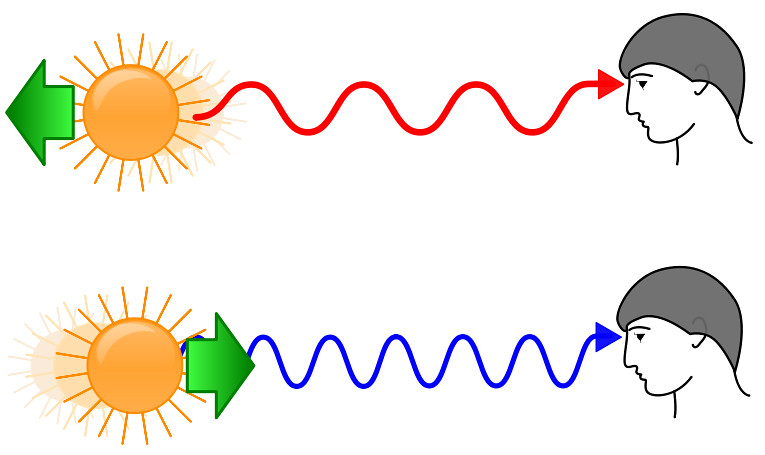
Webb volition be able to see back to about 100 million - 250 one thousand thousand years later on the Large Bang. Simply why do we need to run into infrared lite to understand the early universe? Because calorie-free from these objects is shifted to the cerise. Credit: Aleš Tošovský
+
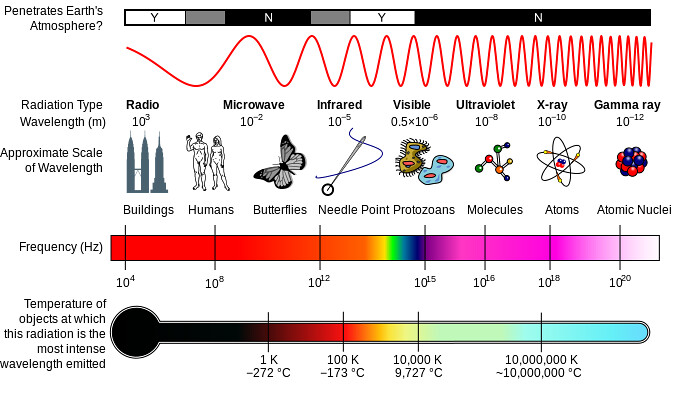
Electromagnetic Spectrum Characteristics Credit: NASA
Redshift ways that light that is emitted by these first stars and galaxies as visible or ultraviolet light, really gets shifted to redder wavelengths past the time nosotros see it here and now. For very high redshifts (i.e., the farthest objects from usa), that visible light is by and large shifted into the virtually- and mid-infrared part of the electromagnetic spectrum. For that reason, to encounter the commencement stars and galaxies, nosotros need a powerful about- and mid-infrared telescope, which is exactly what Webb is!
IN DEPTH
Key Questions
Webb will address several key questions to help usa unravel the story of the formation of structures in the Universe such as:
- When and how did reionization occur?
- What sources acquired reionization?
- What are the first galaxies?
- See also our Q&A with John Mather nigh the Big Bang.
Webb's Part in Answering These Questions
To find the get-go galaxies, Webb will make ultra-deep about-infrared surveys of the Universe, and follow up with low-resolution spectroscopy and mid-infrared photometry (the measurement of the intensity of an astronomical object's electromagnetic radiation). To study reionization, high resolution near-infrared spectroscopy will be needed.
The Era of Recombination
Until effectually a few hundred million years or then after the Big Bang, the universe was a very dark place. In that location were no stars, and there were no galaxies.
Later the Large Bang, the universe was like a hot soup of particles (i.eastward. protons, neutrons, and electrons). When the universe started cooling, the protons and neutrons began combining into ionized atoms of hydrogen and deuterium. Deuterium further fused into helium-4. These ionized atoms of hydrogen and helium attracted electrons turning them into neutral atoms. Ultimately the composition of the universe at this point was three times more than hydrogen than helium with just trace amounts of other light elements.
This process of particles pairing upward is called "Recombination" and it occurred approximately 240,000 to 300,000 years after the Big Blindside. The Universe went from existence opaque to transparent at this betoken. Light had formerly been stopped from traveling freely because it would oftentimes scatter off the free electrons. At present that the free electrons were bound to protons, light was no longer being impeded. "The era of recombination" is the earliest bespeak in our cosmic history to which we tin expect back with any form of light. This is what nosotros see every bit the Cosmic Microwave Groundwork today with satellites like the Catholic Microwave Groundwork Explorer (COBE) and the Wilkinson Microwave Anisotropy Probe (WMAP). Post-obit this are the cosmic dark ages - a period of time after the Universe became transparent but before the offset stars formed. When the first stars formed, it ended the dark ages, and started the next epoch in our universe.
+

Illustration of the Timeline of the Universe. Credit: WMAP
The Epoch of Reionization
Another change occurred after the first stars started to form. Theory predicts that the first stars were 30 to 300 times as massive as our Sun and millions of times equally bright, burning for but a few million years before exploding as supernovae. The energetic ultraviolet calorie-free from these outset stars was capable of splitting hydrogen atoms back into electrons and protons (or ionizing them). This era, from the end of the night ages to when the universe was around a billion years sometime, is known as "the epoch of reionization." It refers to the indicate when most of the neutral hydrogen was reionized by the increasing radiation from the first massive stars. Reionization is an important phenomenon in our universe'southward history as information technology presents one of the few means past which we tin can (indirectly) study these primeval stars. But scientists do not know exactly when the first stars formed and when this reionization process started to occur.
+

Hubble Deep Field - The first significant await back to the era of the universe when early on galaxies were forming. The image is a long exposure of a very pocket-size area of the sky, which revealed a large number of very faint, and previously unseen, objects. These objects are some of the oldest and nearly distant galaxies and allowed us to, as Stefano Cristiani said, "glimpse the beginning steps of galaxy formation more than x billion years ago." Other deeper studies have come after, and Webb will also exercise deep field studies. Webb's imaging capabilties and infrared vision will prove us the early universe with unprecedented clarity. Credit: Robert Williams and the Hubble Deep Field Team (STScI) and NASA
The emergence of these offset stars marks the end of the "Nighttime Ages" in catholic history, a period characterized by the absence of discrete sources of light. Understanding these outset sources is critical, since they greatly influenced the formation of later objects such every bit galaxies. The first sources of calorie-free act as seeds for the later formation of larger objects.
Additionally, the first stars that exploded as supernovae might have collapsed further to form black holes. The black holes started to swallow gas and other stars to become objects known equally "mini-quasars," which grew and merged to become the huge black holes now found at the centers of virtually all massive galaxies.
Source: https://webb.nasa.gov/content/science/firstLight.html
Posted by: connollyshormilt1991.blogspot.com
0 Response to "Astronomers search for light that holds answer to how earliest galaxies formed"
Post a Comment