

The mystery blooms of smelly 'Corpse Flowers'
Corpse Bloom: Facts about the smelly institute
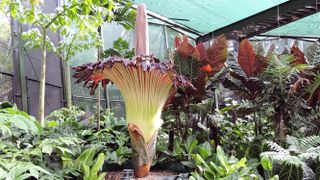
The corpse blossom (Amorphophallus titanum) also known equally titan arum, reeks of rotting flesh and death when in bloom. Lucky for the states, this stinky plant blooms in one case every 7 to nine years co-ordinate to the Eden Project (opens in new tab) and each blossom only lasts 24 to 36 hours.
Not only is the corpse flower one of the smelliest plants on Earth, but it also has the largest collection of flowers (inflorescence) in the world. The unpredictable blooming spectacle makes this enigmatic flower a popular visitor attraction at botanic gardens worldwide. The first corpse blossom to blossom outside its native Sumatra was at Kew Gardens (opens in new tab), Uk. in 1889. The putrid-smelling plant has intrigued botanists since it was starting time scientifically described by Italian botanist Odoardo Beccari in 1878, according to Royal Botanic Garden Edinburgh (opens in new tab).
Native to the rainforests of Western Sumatra, Republic of indonesia, the corpse flower is listed as "endangered" on the International Wedlock for Conservations of Nature'due south (IUCN) Cherry-red List of Threatened Plants. There are fewer than 1,000 individuals thought to be left in the wild according to the U.s.a. Botanic Garden (opens in new tab).
Related: In photos: Stinky 'Corpse Blossom' Blooms
Why does the corpse bloom olfactory property so bad?
In that location is a good reason for the plant's strong odor. "It all comes down to science," said Tim Pollak, outdoor floriculturist at the Chicago Botanic Garden. "The smell, color and even temperature of corpse flowers are meant to attract pollinators and help ensure the continuation of the species."
Pollak explained that dung beetles, flesh flies and other cannibal insects are the main pollinators of this type of flower. These insects typically eat dead flesh. The smell and the dark burgundy color of the corpse blossom are meant to imitate a expressionless animal to attract these insects.
Related: Do indoor plants purify air?
"Corpse flowers are too able to warm upwardly to 98 degrees Fahrenheit (36.7 Celsius) to further fool the insects," Pollak told Live Science. "The insects call back the flower may be food, fly within, realize at that place is zippo to eat, and wing off with pollen on their legs. This process ensures the ongoing pollination of the species. In one case the flower has bloomed and pollination is complete, the flower collapses."
Pollak wrote on the Chicago Botanic Garden's web log (opens in new tab) that analyses bear witness that chemically the stench consists of:
- dimethyl trisulfide (also emitted past cooked onions and limburger cheese)
- dimethyl disulfide (which has an odor like garlic)
- trimethylamine (found in rotting fish or ammonia)
- isovaleric acid (which as well causes sweaty socks to stink)
- benzyl alcohol (a sweet floral scent found in jasmine and hyacinth)
- phenol (sweetness and medicinal, as in Chloraseptic throat spray)
- indole (like mothballs)
Corpse flower anatomy
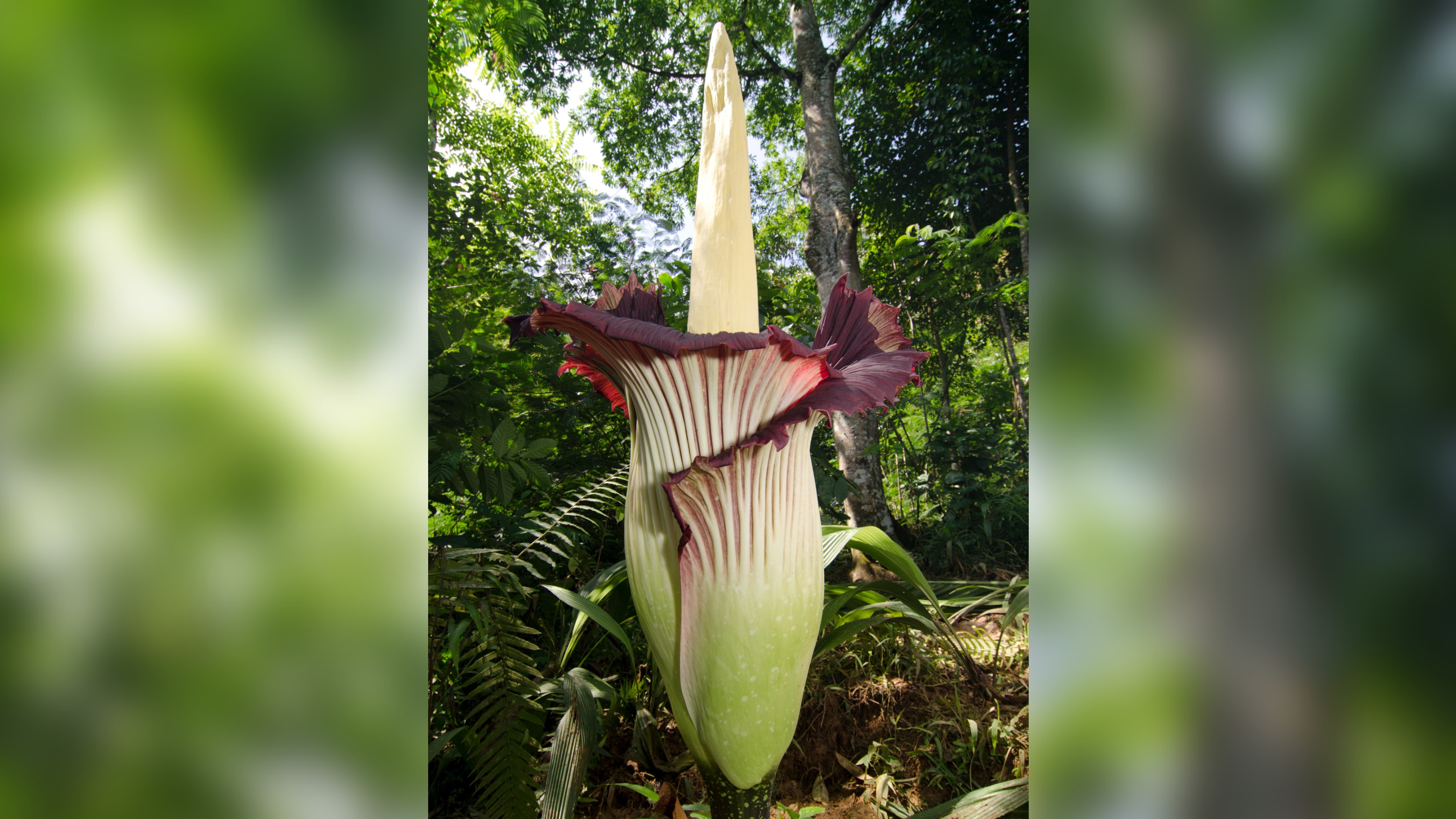
The corpse blossom is what is called an inflorescence — a stalk with many flowers, according to the University of California Botanical Garden (opens in new tab). A mixture of tiny male and female flowers abound at the base of the spadix, the fundamental phallus-like construction, which is surrounded past the spathe, a pleated skirt-like roofing that is bright green on the exterior and deep maroon inside when opened. If pollinated, the spadix grows into a large society-similar head of orange-red seeds.
The establish itself grows to around 10 to xv anxiety (3 to 4.6 meters). The plants typically can grow to a massive 8 feet (ii.four m) alpine and the leaves can exist as big equally 13 feet (four yard) broad. Co-ordinate to the Guinness Book of World Records, the tallest bloom (opens in new tab) was a corpse flower that measured ten feet 2.25 inches (3.1 m) tall. It bloomed on June 18, 2010, at Winnipesaukee Orchids in Gilford, New Hampshire.
Corpse bloom flower
(opens in new tab)
Co-ordinate to the Eden Project (opens in new tab), corpse flowers can have seven to nine years to bloom; some corpse flowers only bloom once every few decades.
Unlike many plants, the corpse flower does not have an almanac blooming cycle. The corpse blossom only blooms when it has sufficient energy to practice so, according to The states Botanic Garden (opens in new tab).
The institute's energy is stored in the corm – a swollen stalk base of operations typically weighing around 100 lbs. (45 kilograms). The corpse institute has the world'south largest known corm, sometimes weighing up to 220 lbs. (100kg). During the non-flowering years, a single leaf, the size of a small tree, shoots upwards from the corm. This foliage branches out into 3 sections with each of these sprouting more than leaflets. Each yr, this shooting leaf dies and a new one grows in its identify. After many years, the plant finally gathers plenty free energy to bloom, and one time it does, it can but hold the bloom for 24 to 36 hours before it collapses.
Related: Do air purifiers help with bad smells?
Considering the flower stays open and emits its aroma for just a few days, information technology can be quite an exciting upshot for scientists and botany enthusiasts. These bloomings garner media coverage and big crowds of visitors. In July 2016, the New York Botanical Garden (opens in new tab) extended its summer hours then that guests could catch a glimpse of the blooming flower. In June 2021, a corpse flower bloomed at the United Stated Botanic Garden, visitors watched the event (opens in new tab) on a live video camera feed posted on the garden'southward website.
Once the blooming begins, it occurs in two stages on consecutive nights: essentially a "female person" phase and a "male" stage. The female flowers class a ring at the bottom of the spadix (inner tube construction), and the male flowers form a ring around the spadix but above the female person flowers.
During the commencement stage, carrion beetles fatigued by the stench of expiry and man-like body temperatures, creep inside the vase-like structure and unknowingly eolith pollen on the receptive female flowers. During the second stage, the construction begins to plummet, the "fragrance" fades and the insects begin to head out. As they get out, the beetles rub upwards confronting the pollen in the male flowers and are now ready to carry the pollen to a nearby female flower.
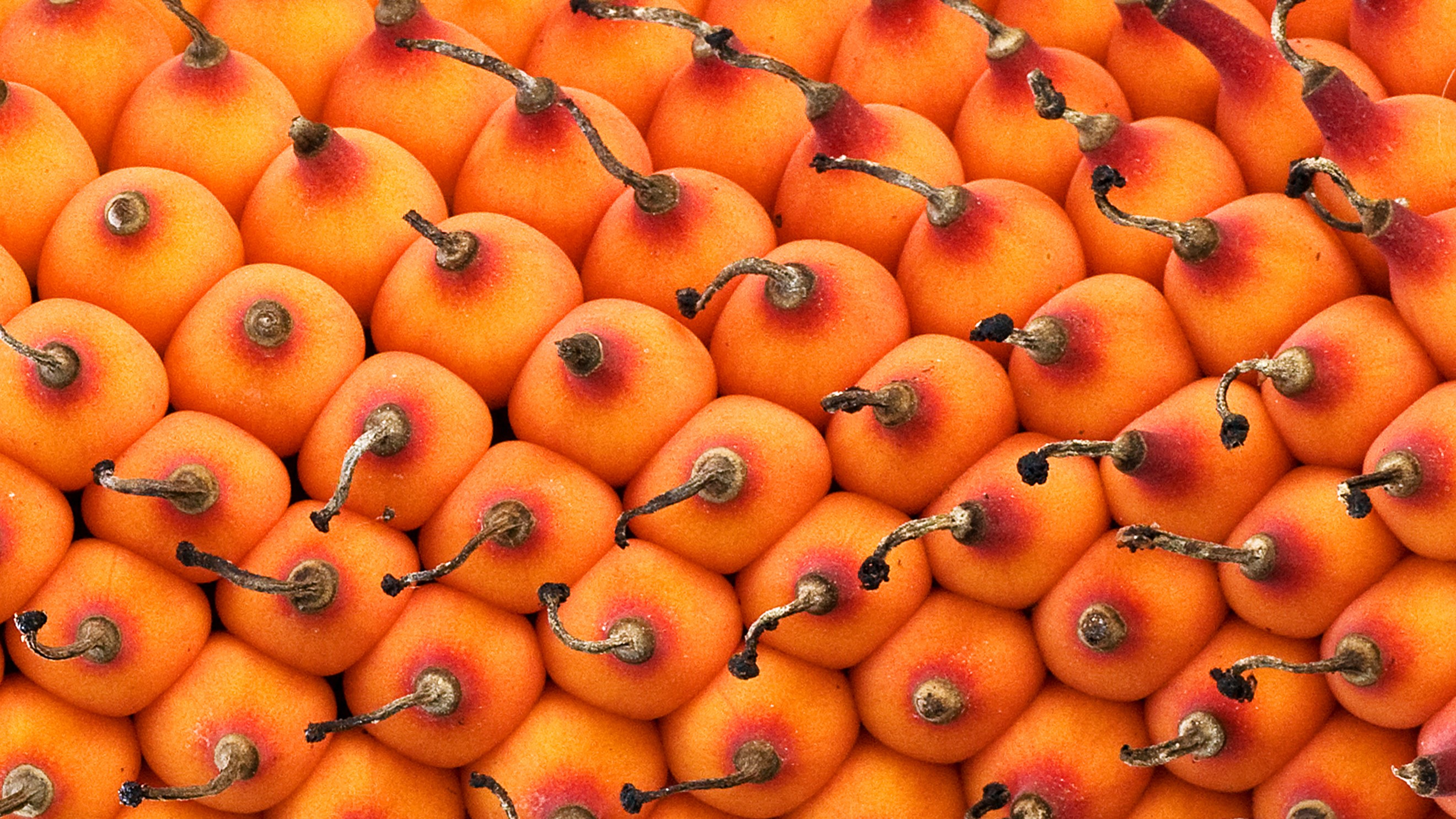
Corpse bloom fruit
(opens in new tab)
If pollination is successful the corpse plant produces vibrant reddish spherical fruit which takes several months to develop co-ordinate to Royal Botanic Garden Edinburgh (opens in new tab).
Each corpse flower can produce over 400 fruits, each containing 2 seeds according to the Chicago Botanic Garden (opens in new tab). These fruits ripen from a gold colour to orange then a rich cherry. When they are fully ripe — approximately six months after pollination — the fruits may look flavory, simply beware as they are poisonous to humans (opens in new tab). In nature, the corpse flower fruit is typically eaten and dispersed by Rhinoceros Hornbills.
The cost of producing so much fruit takes it toll on the corpse flower. According to the Royal Botanic Garden Edinburgh, information technology takes and then much energy to produce the fruit that it usually results in the decease of the plant (opens in new tab). Though there have been some fortunate corpse flowers that accept survived the fruiting processes and gone on to produce further leaves and flowers. If a corpse bloom is not successfully pollinated it volition not produce any fruit and may proceed to and flower in the future.
Corpse bloom name
The scientific proper name of the corpse flower is Amorphophallus titanum. According to Gustavus Adolphus College (opens in new tab), the name is from the Latin words amorphos (without class, misshapen), phallos (penis) and titanum (giant).
The corpse constitute is likewise known as the titan arum, said Ross Koning, a professor of biological science at Eastern Connecticut State University (ECSU). Co-ordinate to the UC Botanical Garden, British naturist and television receiver producer Sir David Attenborough first used the name titan arum in the BBC series "The Private Lives of Plants" because he thought viewers might be offended by the plant'southward Latin proper name. The corpse bloom is in the Aroid subfamily of flowering plants. Relatives include the common duckweed, skunk cabbage, calla lily and Jack-in-the-pulpit.
Taxonomy
Family: Araceae
Order: Arales
Grade: Liliopsida (monocots)
ECSU has two genotypes (genetically different individuals) of corpse flower. "Our genotype known locally equally Rhea has bloomed many times since 2008," said Koning. "Rhea has larger inflorescence parts and a much stronger scent than our other genotype, known locally as Hyperion."
Conservation condition
The corpse blossom is classified as "endangered" on the International Union for Conservation of Nature'southward (IUCN) Carmine List of Threatened Plants (opens in new tab).
According to the ICUN, the wild copse flower population is severely fragmented and has declined past 50% in the last three generations (xc to 150 years). The main threat is habitat loss and destruction. Botanic gardens around the world are playing a crucial role in the conservation of the corpse flower.
According to the ICUN, since the plant was first cultivated in the late 1800s, information technology has been grown in xviii countries across the world in over 90 botanic gardens. The corpse blossom has successfully flowered outside of its native habitat around 100 times.
This article was originally written by Live Science correspondent Alina Bradford and has since been updated
Source: https://www.livescience.com/51947-corpse-flower-facts-about-the-smelly-plant.html
Posted by: connollyshormilt1991.blogspot.com
0 Response to "The mystery blooms of smelly 'Corpse Flowers'"
Post a Comment